
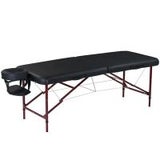
Lightweight massage tables
Aluminium tables from 11 kg for frequent carrying.
View lightweight massage tablesBuying guide · Reviewed October 2026
Every room is different: a bedroom with little floor space, a lounge in a care home, a client who cannot lie down. This guide helps you choose the set-up that fits – table, chair or compact kit – and pack what keeps each visit safe and hygienic.
With the weights, working loads and space needs of our lightweight massage tables, portable massage chairs and compact kits – taken from the manufacturer specifications on each product page.
Free delivery to Mainland UK, including the Scottish Highlands. All prices include VAT. Advice by phone: 020 3773 1242.
| Set-up | Client position | What you carry | Space | Best for | More |
|---|---|---|---|---|---|
| Portable massage table | Lying face down, face up or on the side | 11–24 kg in our range, plus case | About 3 × 2 m | Full-body work with clients who can get on and off a table | Lightweight tables |
| Desktop massage kit | Seated on an ordinary chair at a stable table – or on a suitable mattress | Approx. 2.72 kg with carry bag | A table and a chair | Clients who cannot kneel or get onto a table | View the kit |
| Portable massage chair | Seated, kneeling and leaning forward | 8.1–12.7 kg, plus bag or case | About 2 × 2 m | Back, neck and shoulders for mobile clients who can kneel | Massage chairs |
| The client’s own chair or bed | Seated or lying as they are | Covers, towels and a bolster | As the room allows | Hands, feet, head and shoulders for frail or bed-bound clients | Bolsters |
Many therapists combine two set-ups: a table for home visits and a desktop kit for care home residents who stay seated.
A quick look at the room – or a question on the phone before the first visit – decides which set-up you bring.
A table needs about 3 × 2 m so you can work round it; a chair about 2 × 2 m. Ask before you move furniture – and put it back afterwards.
Stand the table on a firm, level floor. Thick rugs and soft carpet can make it rock – check every leg before the client gets on.
Older clients get cold quickly. A warm room, towels or a massage table heating blanket make the session more comfortable – heating needs a socket nearby.
Stairs, lifts, parking and the distance from the car decide how much weight is realistic, visit after visit.
Weights without bag or case. For frequent stairs, stay with the lightest set-up that still fits your treatments – and use a carry case or wheeled cart on flat routes.
In care settings, the client’s mobility and skin decide more than the treatment plan. Ask, read the care plan and adapt.
Can the client get onto a table, or kneel on a chair? If not, choose the desktop kit or work in their own chair or bed.
Set the table low – most of our portable tables go down to about 60 cm, the ARGO to 58 cm. The client sits on the side first, then lies down; reverse the order to get up.
Sitting on the edge and getting up put the weight on one spot. For care home work we recommend 225 kg or more, and 270 kg or more for larger clients – working load explained.
Older skin is thinner and bruises more easily – adapt your pressure. Avoid reddened, broken or pressure-damaged skin.
Never lift or transfer a client yourself. In care homes, ask the staff to help with transfers – if a client cannot get onto the table safely, change the set-up instead.
Away from your own room, hygiene and safety depend on what you bring – and on following the rules of the place you work in.
Use a non-woven couch roll (40 m × 60 cm), fitted disposable covers or washable sheets – and a fresh face cradle cover (approx. 33 × 33 cm) each time.
Wipe the upholstery, face cradle and armrests between clients with a cleaner that suits PU upholstery, following the manufacturer’s care instructions.
Care homes have their own infection-control rules – follow them, from hand hygiene to how used covers are disposed of.
Ask which conditions, medication and restrictions apply – for example blood thinners, which make bruising more likely – and how consent is given if a resident cannot give it themselves.
Many care homes ask for an enhanced DBS check and proof of insurance before your first visit. Check with the home in advance.
Tick it off the evening before – most forgotten items are the small ones.
Aluminium tables from 11 kg for frequent carrying.
View lightweight massage tables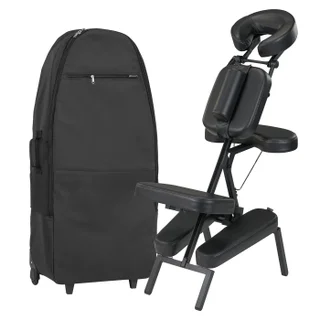
Seated massage for clients who can kneel and lean forward.
View portable massage chairs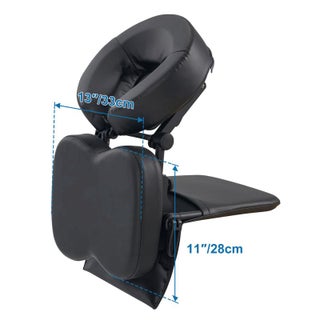
Face cradle, chest pad and arm support for a table or mattress.
View the desktop massage kit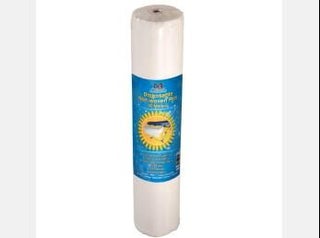
Couch roll, fitted covers and face cradle covers.
View disposable covers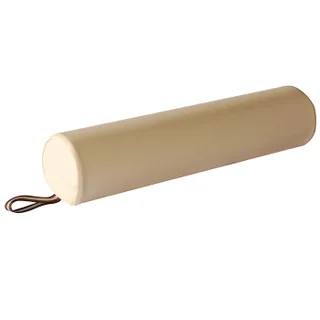
Positioning support for side-lying and seated work.
View bolsters and cushions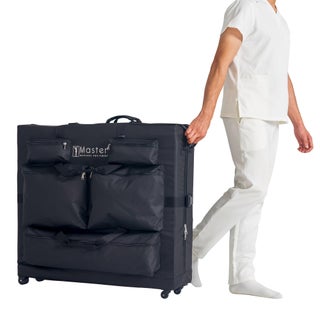
Protect your equipment on the way in.
View carry casesAnswers on set-ups, space, working load and safety.
Yes. A desktop massage kit lets residents stay seated on an ordinary chair at a table, and hands, feet, head and shoulders can be treated in the resident’s own chair or bed. A table is only worth carrying in when the resident can get on and off it safely.
Plan about 3 × 2 m. Set up with the face cradle, a table is about 213 cm long, and you need room to move round it. A portable massage chair needs about 2 × 2 m.
We recommend 225 kg or more, and 270 kg or more for larger clients. Sitting on the edge of the table and getting on and off put a lot of weight on one spot – the rating only applies to a fully opened, level table.
Set the table low – most of our portable tables go down to about 60 cm – let the client sit on the side first and then lie down, and reverse the order to get up. Never lift the client; if getting on is not safe, choose a different set-up.
Only if they can kneel and lean forward comfortably. Many older clients cannot – for them, a desktop kit at a table or a treatment in their own chair is the better choice.
A fresh disposable or washable cover for every resident – couch roll, fitted disposable covers or sheets – plus a fresh face cradle cover. Follow the home’s infection-control rules. See our disposable covers.
Many ask for an enhanced DBS check and proof of insurance, and some for an induction or sign-in procedure. Ask for the information from the care plan that affects the treatment – conditions, medication and consent.
The desktop massage kit weighs approx. 2.72 kg with its carry bag. Our lightest portable chairs weigh 8.1–8.2 kg and our lightest tables 11–11.8 kg, without bag or case.
Tell us where you work – private homes, care homes or both – which treatments you offer and how far you carry your equipment. We compare suitable tables, chairs and kits from our range.
Phone: 020 3773 1242 · Monday to Friday, 9 am – 5 pm